golf launch monitors for home simulators buying guide

Match the sensor type to how much room depth you actually have

The launch monitor that fits your swing isn't always the one that fits your room

Radar, hybrid, and camera-based units need very different amounts of space behind and in front of the ball. Here's how our reviewed 2026 picks compare specifically on room depth, not just accuracy or price.

See the picks by room size
⚡ Limited-time perk

Free two-day delivery on your pick

Dial in your swing faster -- try Amazon Prime free for 30 days, or start a free Audible trial for the drive to the range.

Sponsored link -- we may earn a fee if you sign up. No extra cost to you.

Quick answer: Our top pick for golf launch monitors for home simulators is the Bushnell Launch Pro (Circle B Edition) (Best for Tight Spaces). If you're looking for best for mid-size rooms, the Rapsodo MLM2PRO is a strong alternative.

Room depth rules out more launch monitors than budget does

Reviewed by the DivotBay team · last updated 2026-08-23

Every launch monitor in our main comparison works well outdoors, but indoors, the sensor technology decides how much room you actually need -- and it's not a small difference. A pure radar unit like the Garmin R10 has to sit several feet behind you to read the ball's flight path, then needs real distance in front of you too, for a hard minimum around 18-20 ft of total depth. Fall short of that and accuracy suffers, especially on longer clubs.

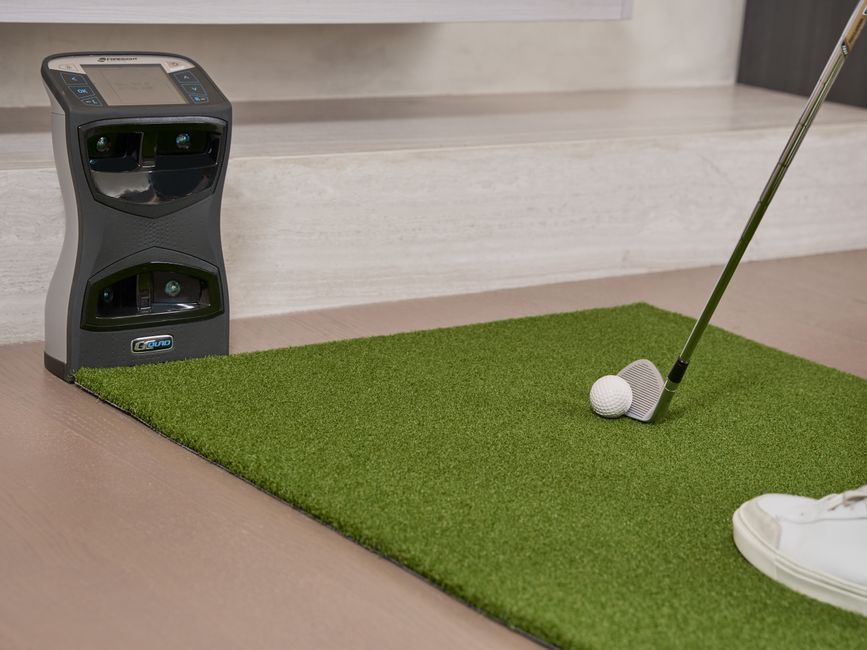
Camera-based and hybrid units solve this differently. A side-mounted camera system like the Bushnell Launch Pro tracks the ball from beside your stance instead of from behind it, which is why it can work in a room as shallow as 13 ft. A hybrid like the Rapsodo MLM2PRO splits the difference -- it still sits behind the ball like a radar unit, but needs meaningfully less flight distance in front of it, landing around 14.5-15.5 ft of total recommended depth.

None of this is about which sensor is 'better' -- it's about which one your actual room can fit. Measure your available depth (garage doors, low ductwork, and support posts all count against you) before picking a unit based on price or features alone, since a launch monitor that can't get accurate reads in your space isn't a bargain at any price.

Measure your real depth first, not just floor space

Garage door tracks, low ductwork, and support posts often cut into usable depth even when the floor looks long enough. Measure to the actual obstruction, not the wall.

Radar needs room behind you, not just in front

Pure radar units like the Garmin R10 need 7-9 ft of clearance behind the golfer on top of ball-flight distance ahead -- a mistake beginners make is only measuring the space between them and the screen.

Side-mounted cameras trade setup simplicity for a smaller footprint

Units like the Bushnell Launch Pro fit shallower rooms because they track from beside the ball, but that placement needs to be set correctly relative to your stance -- worth reviewing the manufacturer's setup guide before assuming any side spot works.

Width and ceiling height still matter

Depth gets the most attention, but most guides also recommend at least 9-10 ft of ceiling height and 10+ ft of width for a comfortable, centered swing -- a deep-enough room that's too narrow or low still won't work well.

Product Best For Price Rating
Bushnell Launch Pro (Circle B Edition) Best for Tight Spaces $2,400 - $2,600 4.8/5
Rapsodo MLM2PRO Best for Mid-Size Rooms $680 - $720 4.6/5
Garmin Approach R10 Best if You Have Full Room Depth $580 - $620 4.6/5
Best for Tight Spaces

Bushnell Launch Pro (Circle B Edition)

4.8

Uses the same side-mounted camera hardware as the Foresight GC3, which tracks the ball from beside your stance rather than needing several feet of clearance behind you -- Bushnell's own spec lists a 13 ft minimum depth, the shortest of any unit in our lineup.

  • Side-mounted camera placement works in rooms too shallow for radar units
  • 13 ft minimum depth spec, well under the other units here
  • Tour-caliber accuracy on top of the smaller footprint
  • Highest price in this comparison by a wide margin
  • More capability than most simulator-only buyers need
Best for Mid-Size Rooms

Rapsodo MLM2PRO

4.6

Its camera-and-radar hybrid sensor sits 6.5-8.5 ft behind the ball and wants around 8 ft of ball flight ahead of it, putting total recommended room depth at roughly 14.5-15.5 ft -- noticeably less than a pure radar setup, without the side-mount learning curve of a camera-only system.

  • Roughly 14.5-15.5 ft recommended depth, well short of radar-only units
  • Sits behind the ball like a radar unit, no side-mount setup to learn
  • Broadest simulator software compatibility in this lineup
  • Still needs more depth than a true side-mounted camera system
  • Full data access requires a $199/year subscription after the 45-day trial
Best if You Have Full Room Depth

Garmin Approach R10

4.6

A pure radar unit that needs to sit 7-9 ft behind the golfer plus at least 10 ft of ball-to-screen distance, for a hard minimum of about 18-20 ft of total room depth -- the most space-hungry setup in our lineup, but also the most portable if you ever want to take it outdoors instead.

  • Strong balance of portability, accuracy, and simulator features for the price
  • Doubles as an outdoor range unit if you ever move it out of the simulator room
  • Long battery life and small enough to carry to the range
  • Needs roughly 18-20 ft of total room depth, the most of any unit here
  • Radar placement needs a careful, repeatable indoor setup for best accuracy